
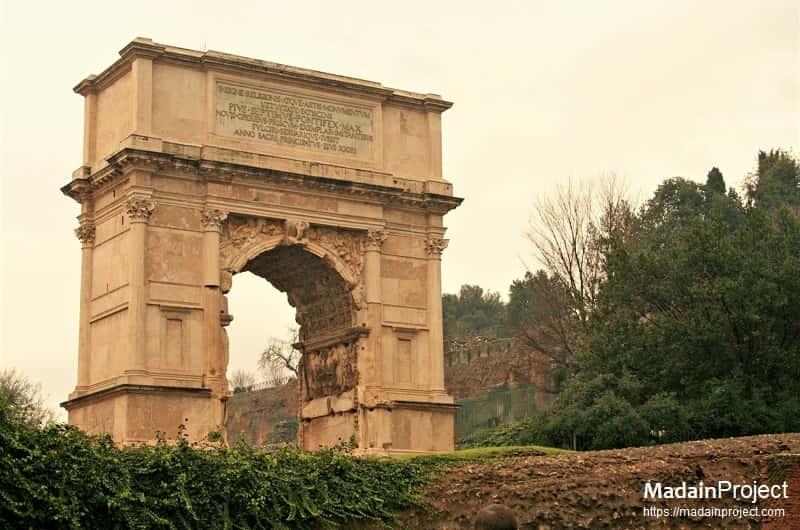
The Arch of Titus (Arco di Tito), known as the Arcus Titi in Latin, is a first century CE honorific arch, located on the ancient Via Sacra, just to the south-east of the Roman Forum. It was constructed circa 81 CE by the Emperor Domitian shortly after the death of his older brother Titus to commemorate his official deification or consecratio and the victory of Titus together with their father, Vespasian, over the Jewish rebellion in Judaea, today known as the Great Jewish Revolt (circa 66-74 CE).
The Arch of Titus, situated in the heart of ancient Rome east of the Flavian Amphitheater, just like other triumphal arches across the ancient Roman world, has long been understood as a testament and monument to the military prowess of the Roman Empire.
The arch is most famous for its depiction of "temple loot" from the Second temple of Jerusalem, as the triumphal procession celebrated in 71 CE after the Roman victory culminating in the fall of Jerusalem. The reliefs on the inner side of the arch provide one of the few contemporary depictions of temple implements and other items from the Herod's Temple (or the Second Jewish temple). It became a symbol of the Jewish diaspora, and the menorah depicted on the arch served as the model for the menorah used as the emblem of the state of Israel.
Although commonly believed to depict the triumphal procession of the Flavian triumph with people carrying the items, such as a Jewish menorah, the arch or the panels do not bear any inscription to identify the scenes. The Jewish historian Josephus Flavius notes that this was the only triumph in which all three Flavians took part: "Vespasian drove along behind the spoils and Titus followed him; Domitian rode beside them, dressed in a dazzling fashion and riding a horse which was worth seeing".
The arch is surrounded by a number of notable ancient monuments, including Temple of Venus and Roma, Santa Francesca Romana, House of Marcus A. Scaurus, and Basilica of Maxentius.

circa 81 CE

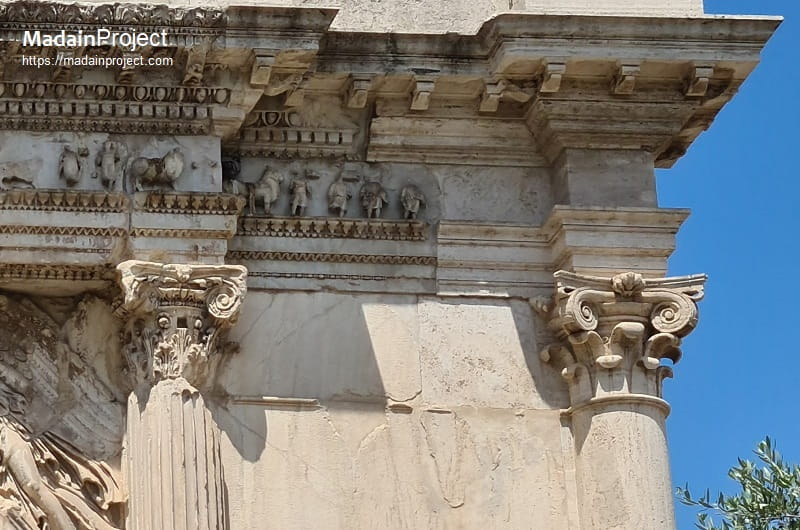
The Arch of Titus, thought to have been designed and constructed by Rabirius (an ancient Roman architect who lived during the first and second centuries CE), measures 15.4 meters (50 feet) in height, 13.5 meters (44 feet) in width, 4.75 meters (15.5 feet) in depth. The inner archway is 8.3 meters (27 feet) in height, and 5.36 meters (17.5 feet) in width. It is a structure made of white marble. The arch is single-pass and has four columns in the Corinthian order situated on the facades. The columns with smooth stems are on the sides, and the columns are decorated with channels on the inside. The arch is large with both fluted and unfluted columns (inspect), the latter being a result of 19th-century restoration.
The arch features a sophisticated application of the Composite order, marking one of the earliest and most influential deployments of this Roman architectural synthesis. It is believed to be the oldest extant example of Roman composite order architecture. The four engaged columns flanking the central passageway are characterized by capitals (inspect) that fuse the volutes of the Ionic order with the acanthus leaf motifs of the Corinthian, a hybridity that exemplifies the Flavian appetite for ornamental density and visual opulence. These columns are set upon high, discrete pedestals rather than a continuous stylobate, a structural innovation that elevates the triumphal imagery and projects a sense of monumental verticality. By integrating these fluted shafts with a richly carved entablature and a prominent attic story, the architects achieved a rhythmic articulation of the facade that transcends mere structural necessity, establishing a canonic template for the triumphal arch that would dominate Western classicism through the Renaissance.
circa 81 CE

Triumphal Procession with Jewish Menorah Relief
The so-called "Spoils of Jerusalem" relief (inspect), situated on the south interior wall of the Arch of Titus, constitutes a seminal development in Roman illusionistic relief sculpture, characterized by its sophisticated manipulation of spatial depth. The composition depicts the pompa triumphalis in 71 CE, specifically the moment the triumphal procession passes through a designated archway—an ingenious meta-narrative device that mirrors the viewer's own physical position. The sculptors utilized varying degrees of relief height, transitioning from nearly three-dimensional figures in the foreground to shallowly incised outlines in the background, to create an atmospheric recession that suggests a vast, moving crowd. This technical virtuosity allows the treasures looted from the Second Temple, most notably the seven-branched menorah, to appear as if it is being physically carried across the viewer's field of vision, rather than remaining a static, two-dimensional frieze.
Iconographically, the relief serves as a primary source for the reconstruction of Herodian liturgical furniture, providing a rare contemporary visualization of the Golden Table of Shewbread and the Silver Trumpets alongside the menorah. The presence of tituli—placards identifying the conquered cities and spoils—underscores the relief’s function as a permanent record of Flavian hegemony and the successful suppression of the First Jewish-Roman War. By immortalizing the transport of these highly specific religious objects into the Roman Manubiae, the relief functions as a potent instrument of Imperial propaganda, signifying the absolute transition of divine favor from the God of Israel to the Roman state. This narrative strategy effectively decontextualizes the Jewish artifacts, transforming them into trophies that validate the legitimacy of the nascent Flavian dynasty.
Athough a bit difficult to discern there are some other sacred objects being carried in the triumphal procession, such as the Gold Trumpets, the fire pans for removing the ashes from the altar, and the Table of the Showbread. These sacred objects were most likely originally colored gold (inspect), with the background in blue.
circa 81 CE

Titus Triumphator Relief
The Triumph of Titus relief panel, located on the interior southern wall of the arch’s passageway, represents a seminal development in Roman historical narrative sculpture through its sophisticated manipulation of spatial depth and illusionistic perspective. The composition depicts Titus as the triumphator standing within a four-horse chariot or quadriga, lead by a helmeted Amazonian, Valour, accompanied by a winged Victory who crowns him with laurel, while allegorical personifications of the Roman Senate (Genius Senatus) and the Roman People (Genius Populi) guide the procession. Unlike the flatter, more linear registers of earlier Hellenistic friezes, the Flavian sculptors employed varying degrees of relief height—ranging from nearly free-standing figures in the foreground to shallowly incised outlines in the background—to create a sense of atmospheric recession and a crowded, moving assembly.
This work is structurally significant for its transition from the purely descriptive to the symbolic and divine, effectively deifying the emperor by integrating mortals and deities within a singular, coherent spatial field. The juxtaposition is significant in that it is one of the first examples of divinities and humans being present in one scene together. This contrasts with the panels of the Ara Pacis, where humans and divinities are separated.
circa 81 CE

Eastern Inscription of Titus and Vespasian
The large ancient Roman inscription on the eastern attic is the primary text on the Arco Tito, deifying emperor Vespasian and by extension Titus. The original inscription is attached to the eastern facade of the Arch of Titus. The inscription is absolutely enormous and could have been fairly easily seen and read from a distance. It is written in Roman square capitals and reads:
SENATVS
POPVLVSQVE·ROMANVS
DIVO·TITO·DIVI·VESPASIANI·F(ILIO)
VESPASIANO·AVGVSTO
Translation: "The Senate and the Roman people (dedicate this) to the deified Titus Vespasian Augustus, son of the deified Vespasian".
The inscription on the arch emphasized on the divinity of Vespasian and Titus, the deified emperors. And since Domitian was part of the family, his claim to the legitimacy was based on military prowess of his father and brother, and on their divinity. Still, the inscription on the arch doesn’t directly implies a claim for Flavian legitimacy or even Domitian’s legitimacy with linear, discursive means of communication.
circa 81 CE

Western Inscription of Pope Pius VII
The western attic bears an inscription dating back to the 1821 CE, inscribing the restoration during the reign of Pope Pius VII. The restorations were supervised by Giuseppe Valadier.
INSIGNE · RELIGIONIS · ATQVE · ARTIS · MONVMENTVM
VETVSTATE · FATISCENS
PIVS · SEPTIMVS · PONTIFEX · MAX(IMVS)
NOVIS · OPERIBVS · PRISCVM · EXEMPLAR · IMITANTIBVS
FVLCIRI · SERVARIQVE · IVSSIT
ANNO · SACRI · PRINCIPATVS · EIVS · XXIIII
The inscription translates: (This) monument, remarkable in terms of both religion and art, had weakened from age: Pius the Seventh, Supreme Pontiff, by new works on the model of the ancient exemplar ordered it reinforced and preserved. In the 24th year of his sacred rulership.
circa 81 CE

Coffered Vault and the "Titus on Eagle" Relief
The ceiling of the single arched passage is decorated with coffers with sculptured rosettes and rich mouldings. The central theme depicted on the arch revolves around the apotheosis of Roman emperor Titus, prominently showcased in the vault of the archway. In this representation, the deified Titus is borne aloft by a colossal eagle (inspect), a symbol associated with Jupiter and the city of Rome. This imagery vividly portrays the pivotal moment during the state funeral of emperor Titus, symbolizing the sacred moment when his consecrated soul ascended directly to the heaven from the funeral pyre. In the imperial funerals of the second and the centuries CE, a live eagle was traditionally released from the burning funeral pyre, serving as a symbolic manifestation of the miraculous process of apotheosis.
circa 1821 CE

The Arch of Titus was extensively restored during the pontificate period of Pope Pius VII. Giuseppe Valadier, an Italian architect and designer, urban planner and archaeologist and a chief exponent of Neoclassicism, oversaw the restoration activity. The arch was extensively restored including the outer portion of the arch, and exterior columns (circa 1821-1822 CE). During this restoration travertine limestone was used in order to differentiate between the original and the restored portions.
A number of artists, such as Giovanni Paolo Panini (1740 CE), Giovanni Battista Piranesi (1748-1774 CE), Canaletto (1744 CE), painted the Arch of Titus before its restoration, which show the triumphal arch in quite a state of disrepair.


Signup for our monthly newsletter / online magazine.
No spam, we promise.

The Madain Project is an online archive of Abrahamic History and Archaeology.
Abrahamic History & Archaeology is the study of history and archaeology with respect to the three Abrahamic Faiths without considering the religious and theological aspects. The goal of Abrahamic History is to understand how and why the religious doctrines and behaviours have evlovled and changed over time. Searching for patterns in the evolution of significant cultural events such as the development of farming, the emergence of cities, or the collapse of major civilizations for clues of why and how these have influenced the three major Abrahamic religions.
Cloud Drive -
About -
Help -
Editorial Policy -
AI Policy -
Privacy Policy -
Contact
Madain Project: Encyclopedia of Abrahamic History & Archaeology.
Copyright MadainProject 2017 - 2026.


