
The "Art of Ancient Pompeii" encompasses the diverse array of visual and decorative artistic works produced in the ancient Roman city of Pompeii before its destruction in 79 CE by the eruption of Mount Vesuvius. These works of art include frescoes, mosaics, sculptures, and everyday items or artifacts that illustrate the aesthetic sensibilities, cultural practices, and daily life of the ancient Roman city's inhabitants.
Ancient Pompeii, a city frozen in time by volcanic ash, offers a unique and invaluable glimpse into the artistic achievements of the Roman era. The art of Pompeii is renowned for its vibrant frescoes that adorned the walls of homes, public buildings, and temples, depicting mythological scenes, landscapes, and everyday activities with remarkable detail and color. Mosaics, another prominent feature, decorated floors with intricate designs and narratives, showcasing both geometric patterns and figural representations.
Sculptures found in Pompeii range from grand marble statues of deities and notable individuals to smaller, everyday items like household gods (lares). These artworks reflect a blend of Greek and Roman influences, illustrating the cultural exchange prevalent in the ancient world. Additionally, the decorative arts, including pottery, jewelry, and metalwork, highlight the craftsmanship and artistic flair of Pompeian artisans.
The preservation of Pompeian art provides scholars with crucial insights into Roman life, social structure, and aesthetics. The city's sudden burial under volcanic ash created a time capsule, preserving details that have otherwise been lost to history in other Roman cities. Today, the art of Ancient Pompeii continues to captivate and educate, offering a vivid connection to the past.

circa 200 BCE- 79 CE
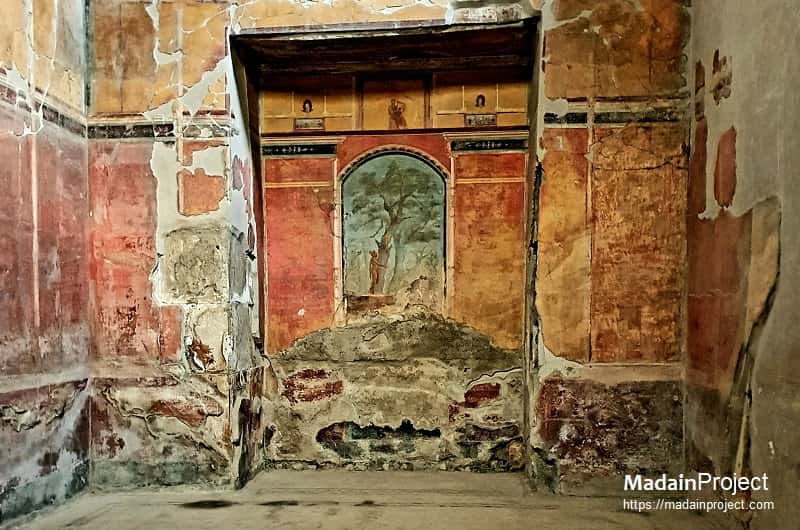
The Pompeian Styles refer to four distinct phases of Roman wall painting that developed in Pompeii and surrounding areas, each with its own characteristics and techniques. The First Style, also called the Incrustation Style (circa 200–80 BCE), was characterized by its imitation of marble panels, creating the illusion of luxury and opulence by painting walls to resemble costly materials like marble and limestone. Examples of this style can be found in the House of the Samnite in Herculaneum.
The Second Style, or Architectural Style (circa 80–15 BCE), introduced the illusion of depth and perspective, with painted architectural elements like columns, windows, and open vistas creating the illusion of a room extending into space. A prime example is the Villa of the Mysteries in Pompeii, where intricate illusionistic scenes unfold across the walls.
The Third Style (circa 15 BCE–50 CE), also known as the Ornate Style, emphasized delicate, intricate decorative details with large, flat areas of color and small, finely detailed motifs like floral patterns and mythological scenes. The Villa of Agrippa Postumus at Boscotrecase is a notable example, with its minimalistic architecture and focus on mythological imagery.
The Fourth Style, or Intricate Style (circa 50–79 CE), marks the final evolution of Pompeian wall painting, characterized by a chaotic blend of architectural illusion, mythological scenes, and vibrant colors, often overlapping in a way that creates a sense of visual disarray. This style incorporated elements from the First and Second Styles but with more complex compositions, featuring multiple layers of panels, framed pictures, and intricate scenes. Examples of this style can be found in the House of the Vettii in Pompeii, which contains dramatic mythological scenes and vibrant wall decorations. The Fourth Style often included depictions of gods, landscapes, and narrative cycles in a way that was more dynamic and less cohesive compared to earlier styles.
circa

Larariums
In the homes of Pompeii, larariums were small household shrines dedicated to the Lares, the guardian spirits of the home. Typically located in a private or semi-public space, such as the atrium or peristyle, the lararium featured an altar or niche where offerings could be made to these protective deities. The shrine was often adorned with frescoes or small statues depicting the Lares, and sometimes included representations of the Penates (household gods of the pantry) or Genius (the spirit of the household’s head). The House of the Vettii and House of the Faun are examples where larariums are richly decorated with detailed imagery, emphasizing the importance of domestic worship. These shrines were not only an architectural feature but also a reflection of the deep connection between Roman religion and daily life, ensuring protection and prosperity for the family.
circa

Mosaic Columns
Mosaic columns were a distinctive feature of Pompeian architecture, often used to enhance the visual appeal of both private homes and public buildings. These columns, typically crafted from small colored tiles (tesserae), were meticulously assembled to create intricate patterns or depictions, adding an artistic flair to the structural elements of the building. Often placed at the entrances, in courtyards, or around peristyles, mosaic columns served both aesthetic and symbolic purposes. A notable example can be found in the House of the Faun and the so-called House of the Mosaic Columns where columns are adorned with vibrant geometric and mythological motifs that mirror the opulence and artistic sophistication of the space.
These columns, while primarily decorative, were also a demonstration of wealth and status, as the labor-intensive mosaic work was a symbol of the homeowner's affluence and appreciation for fine art. The use of mosaic columns in Pompeii exemplifies the seamless integration of art with architecture, showcasing the Romans' ability to blend functionality with artistic expression.
circa

Dionysiac Mysteries Fresco
The Dionysiac Mysteries Fresco, located in the Villa of the Mysteries on the outskirts of Pompeii, is one of the most famous and well-preserved examples of Roman fresco painting. This intricate and vibrant artwork, dating back to around 60-50 BCE, depicts a series of scenes related to the initiation rites of the Dionysian Mysteries, a secret cult dedicated to the god Dionysus (Bacchus).
The fresco spans an entire room in the villa, known as the Initiation Chamber. The walls are covered with a continuous frieze that unfolds like a visual narrative, illustrating various stages of the Dionysian initiation ritual (or according to some preparation of a wedding). The scenes are populated with life-sized figures, including participants, mythological creatures, and deities.
Central to the fresco is the depiction of Dionysus, the god of wine, ecstasy, and theater, reclining with his consort Ariadne. This scene signifies the divine presence overseeing the initiation. Various stages of the initiation process are illustrated, showing female initiates undergoing rituals of purification, symbolic death, and rebirth, and participating in ecstatic dances. Satyrs, maenads (female followers of Dionysus), and other mythological figures are interspersed throughout the scenes, contributing to the mystical and otherworldly atmosphere of the fresco. The fresco is rich in symbolic content, reflecting themes of transformation, the cyclical nature of life and death, and the transcendence of ordinary existence through mystical experience.
The fresco features a vivid palette with deep reds, greens, and blues, creating a striking visual impact. The artists employed techniques to create an illusion of depth and three-dimensionality, enhancing the realism of the figures and scenes. The arrangement of figures and the flow of the narrative contribute to a sense of movement and drama, drawing the viewer into the unfolding story.
The Dionysiac Mysteries Fresco offers invaluable insights into the religious and social practices of ancient Pompeii. It highlights the importance of mystery cults in Roman society, where initiates sought spiritual enlightenment and communion with the divine through secret rites. The fresco also reflects the broader Roman appreciation for Greek culture, mythology, and artistic traditions.
circa

Venus in the Shell Fresco
The Venus in the Shell Fresco is a captivating piece of Roman art discovered in the ancient city of Pompeii. This fresco, located in the House of Venus (Casa della Venere), is one of the most exquisite representations of Venus, the Roman goddess of love and beauty. Dating back to the first century CE, this artwork reflects the cultural and artistic influences of the time.
The fresco depicts Venus, the Roman equivalent of the Greek goddess Aphrodite, emerging from the sea on a large, scallop-shaped shell. She is portrayed as a strikingly beautiful woman, standing nude with flowing hair that accentuates her divine beauty. Surrounding her are various sea creatures, including dolphins and fish, emphasizing her connection to the ocean.
Central to the fresco is the figure of Venus, depicted in a contrapposto stance that highlights the naturalistic portrayal of the human body. Her posture and gaze exude grace and allure, embodying the ideals of feminine beauty and sensuality. Venus stands on a large, open shell, a motif that symbolizes her birth from the sea. The shell is often associated with themes of fertility and regeneration. The fresco includes a variety of sea creatures, adding to the scene's vibrancy and reinforcing the goddess's connection to the maritime world. Dolphins, often considered sacred to Venus, are prominent in the composition. The background of the fresco features a serene seascape with gentle waves and an expansive sky, creating a harmonious and idyllic setting for the goddess's appearance.
The Venus in the Shell Fresco reflects the Roman admiration for Greek mythology and art, illustrating the syncretism between Greek and Roman cultures. Venus, as a symbol of beauty, love, and fertility, held significant importance in Roman religion and daily life. The fresco also provides insights into the domestic decoration and aesthetic preferences of Pompeian residents, who adorned their homes with mythological and nature-themed artworks.
circa

Alexander Mosaic
The Alexander Mosaic is one of the most renowned pieces of ancient art discovered in the Roman city of Pompeii. This intricate and detailed floor mosaic, dating back to approximately 100 BCE, depicts a dramatic battle scene featuring Alexander the Great and Darius III of Persia. The mosaic was discovered in the House of the Faun, one of Pompeii's largest and most luxurious residences, and is considered a masterpiece of Hellenistic art.
The mosaic captures the intense and chaotic moment of the Battle of Issus (333 BCE), where Alexander the Great secured a significant victory over the Persian king Darius III. The scene is teeming with dynamic action, vivid expressions, and a multitude of figures, horses, and weaponry, showcasing the artist's ability to convey movement and emotion.
In the left section of the mosaic, Alexander is portrayed bare-headed, emphasizing his fearlessness. He is depicted charging into battle on his horse, Bucephalus, with a determined and focused expression, leading his troops against the Persian forces. On the right side, Darius III is shown in a chariot, turning back to look at Alexander with a gesture of desperation and alarm. His facial expression and posture reflect the tension and impending defeat. The mosaic is filled with soldiers, horses, and weaponry in various stages of combat. The detailed depiction of armor, weapons, and the contorted bodies of the fighters adds to the realism and intensity of the scene.
The mosaic is composed of millions of tiny tesserae (small pieces of colored stone or glass), meticulously arranged to create detailed images with subtle gradations of color and shading. The artist employed techniques of light and shadow to create a three-dimensional effect, enhancing the realism of the figures and the sense of depth in the composition. The diagonal lines and overlapping figures convey a sense of motion and chaos, effectively capturing the frenzied nature of battle.
It provides a visual representation of one of Alexander the Great's most famous battles, offering insights into ancient military attire, strategies, and iconography. The mosaic reflects the influence of Greek art on Roman culture, showcasing the Romans' admiration for Hellenistic artistic techniques and themes. The level of detail and skill involved in creating the mosaic highlights the sophistication of ancient mosaic art and the technical prowess of its craftsmen.
Today, the original Alexander Mosaic is housed in the National Archaeological Museum in Naples, where it continues to be a subject of extensive study and admiration. A replica of the mosaic can be seen in situ in the House of the Faun in Pompeii, giving visitors a glimpse into the grandeur of ancient Roman homes and the cultural significance of Alexander the Great's legacy.
circa

Statuette of the Faun
The Statuette of the Faun, discovered in the so-called "House of the Faun", is a notable example of ancient Roman sculpture, renowned for its exquisite craftsmanship and artistic expression. This small bronze figurine, discovered in Pompeii, depicts a faun—a mythological creature from Roman mythology associated with fertility, nature, and rusticity.
The statuette portrays a faun in a dynamic and lifelike pose, capturing the essence of this mythical creature. Fauns were often depicted as half-human, half-goat beings, known for their mischievous and playful nature. The figure is typically shown with pointed ears, a tail, and sometimes small horns, embodying the faun's animalistic attributes.
The faun is depicted in a lively pose, possibly dancing or playing a musical instrument such as a flute (a common attribute of fauns in art). The gesture and movement convey a sense of spontaneity and vitality. Despite its small size, the statuette is intricately detailed, with emphasis on the faun's facial features, musculature, and anatomy. The artist skillfully rendered the texture of the faun's hair and the folds of its drapery or skin.
The statuette is made of bronze, a material favored by Roman sculptors for its durability and ability to capture fine details. Roman bronze statuettes like the Faun were often created using the lost-wax casting technique, allowing for precise reproduction of intricate designs.
The Statuette of the Faun reflects the Romans' fascination with Greek mythology and their adaptation of Greek artistic styles. The faun motif was popular in Roman art, appearing in various forms across sculptures, mosaics, and decorative arts.
The statuette was discovered in Pompeii, a Roman city buried under volcanic ash by the eruption of Mount Vesuvius in 79 CE. The ash preserved many artworks and artifacts, including the Statuette of the Faun, providing valuable insights into Roman life and culture. Today, examples of the Statuette of the Faun can be found in museums worldwide, where they are admired for their artistic merit and historical significance. These statuettes offer a tangible connection to the artistic achievements of ancient Rome and continue to inspire fascination and study among archaeologists, historians, and art enthusiasts.
circa

Fresco of the Orchard
The fresco in the House of the Orchard in Pompeii is an exceptional example of Roman garden painting, vividly depicting a lush, illusionistic garden within a private residential room (cubiculum). Created in the Third Pompeian Style during the Augustan period (early 1st century CE), the artwork transforms the small room into a serene, verdant oasis by covering all four walls with detailed depictions of various fruit and ornamental trees, including lemon, strawberry, pear, cherry, and fig trees. The exquisite precision of the painting allows modern observers to identify the plant species.
The scene is animated by numerous fluttering birds, and notably features a snake coiled around the central fig tree, a powerful symbol of prosperity and good fortune in Roman culture. The frescoes also incorporate Egyptian-inspired motifs, such as symbols of the goddess Isis, hinting at the owner's potential devotion to the deity and adding a layer of exotic, spiritual significance to the domestic space. The house is remarkable because this type of elaborate garden imagery was typically reserved for grander reception rooms in other Pompeian villas, but here it was used to create a peaceful, personal retreat for rest and relaxation.
circa

Mural of the Greek Playwright Menander
The House of the Menander in Pompeii is celebrated for its well-preserved frescoes, including a notable mural (possibly) depicting the person of the Greek playwright Menander. This ancient Roman villa provides a glimpse into the cultural tastes and artistic sophistication of Pompeian society during the first century BCE. The mural dedicated to Menander in the House of the Menander is a significant example of Roman appreciation for Greek literature and theater. Menander, a renowned playwright of ancient Athens (circa 342–291 BCE), was known for his comedies that portrayed everyday life and human foibles with wit and insight. The fresco likely served as a homage to Menander's literary legacy and as a form of cultural adornment within the villa.
circa
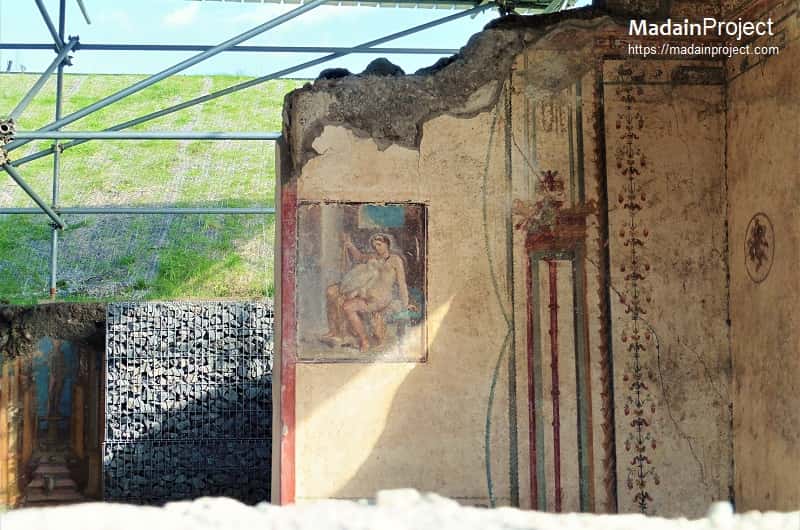
Leda and the Swan Fresco
The Leda and the Swan Fresco in Pompeii is a renowned ancient Roman artwork depicting the mythological tale of Leda and Zeus transformed into a swan. This relatively small fresco, discovered in the ruins of one of the residential houses of Pompeii, exemplifies the Roman fascination with Greek mythology and the artistic skill of Pompeian painters. The fresco portrays the mythological scene of Leda, the queen of Sparta, being seduced by Zeus in the form of a swan. According to Greek mythology, Zeus approached Leda while she was bathing or gathering flowers near a river. The union between Leda and Zeus resulted in the birth of several offspring, including Helen of Troy and Pollux.
The fresco prominently features Leda and the swan, capturing the moment of their encounter. Leda is depicted in a graceful pose, often nude or semi-nude, emphasizing her beauty and vulnerability. Zeus, transformed into a swan, is shown with wings and a swan's neck, symbolizing his divine guise. The myth of Leda and the Swan was often interpreted allegorically in ancient art and literature. It symbolizes themes of divine intervention, seduction, and the consequences of human interaction with gods.
circa

Wall Graffiti and Dipinti
In Pompeii, wall graffiti and dipinti (singular: dipinto) provide invaluable glimpses into the daily lives, thoughts, and culture of its ancient inhabitants. Unlike the elaborate frescoes and mosaics that adorn Pompeian homes and public buildings, these inscriptions offer a more direct and personal connection to the people who lived there.
Wall graffiti in Pompeii consists of informal, often spontaneous writings or drawings scratched or painted directly onto walls, often in public spaces. Graffiti cover a wide range of topics, including personal messages, political slogans, declarations of love, advertisements, and even crude jokes. They reflect the multicultural nature of Pompeii, with inscriptions in Latin, Greek, and even Oscan (an Italic language spoken in southern Italy).
Dipinti are more formal inscriptions painted or scratched onto walls, typically in red or black ink. They include announcements, legal notices, political messages, and records of business and shop names. Dipinti provide insights into administrative practices, economic activities, and public communication in Pompeii. Dipinti are important for reconstructing the economic and legal landscape of Pompeii before its destruction. They are studied in conjunction with other archaeological finds to provide a comprehensive understanding of ancient Pompeian society.
Wall graffiti and dipinti in Pompeii represent a form of direct communication from the ancient past, offering a mosaic of voices that enrich our understanding of daily life, social relationships, and cultural practices in this vibrant Roman city. Their preservation underscores their importance as cultural artifacts and their role in shaping scholarly interpretations of Pompeii's history.

Signup for our monthly newsletter / online magazine.
No spam, we promise.

The Madain Project is an online archive of Abrahamic History and Archaeology.
Abrahamic History & Archaeology is the study of history and archaeology with respect to the three Abrahamic Faiths without considering the religious and theological aspects. The goal of Abrahamic History is to understand how and why the religious doctrines and behaviours have evlovled and changed over time. Searching for patterns in the evolution of significant cultural events such as the development of farming, the emergence of cities, or the collapse of major civilizations for clues of why and how these have influenced the three major Abrahamic religions.
Cloud Drive -
About -
Help -
Editorial Policy -
AI Policy -
Privacy Policy -
Contact
Madain Project: Encyclopedia of Abrahamic History & Archaeology.
Copyright MadainProject 2017 - 2026.


