
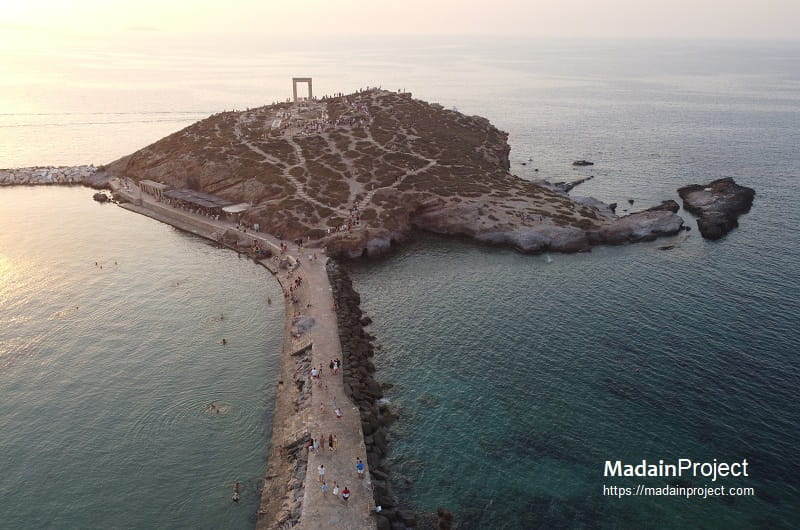
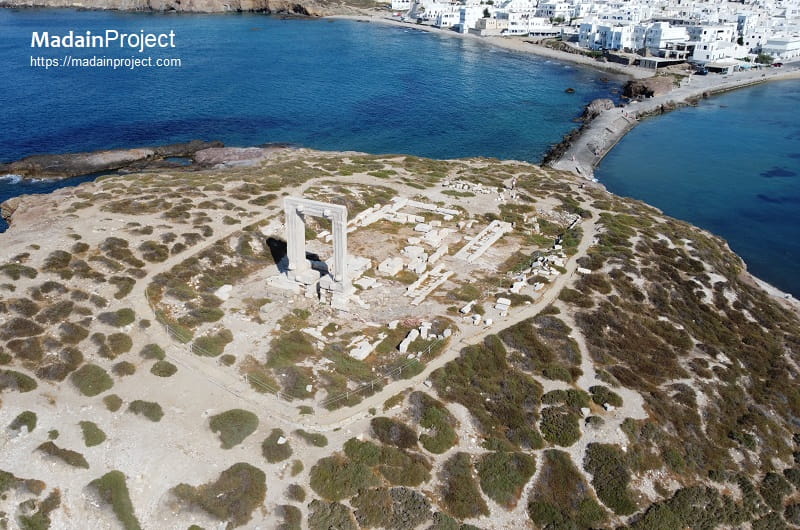
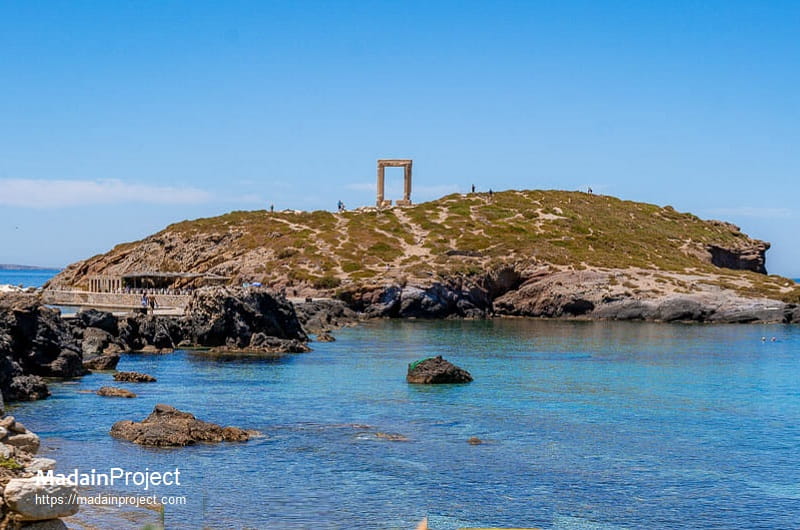
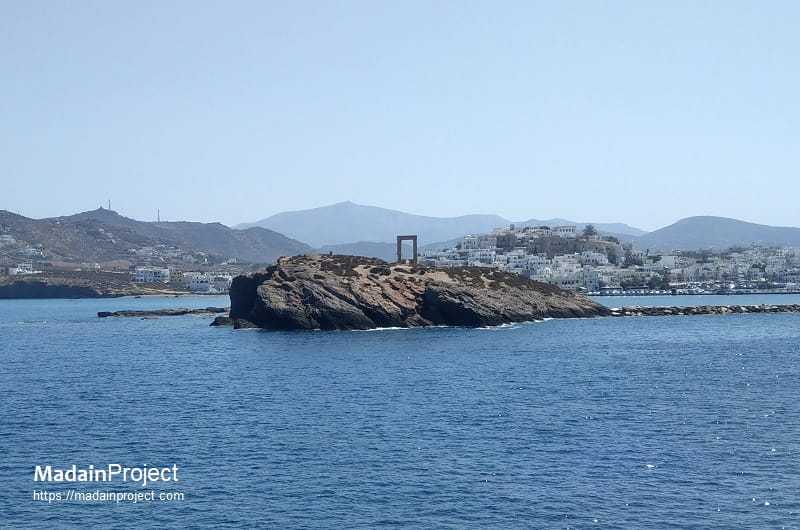
Palatia or the islet of Palatia is a small, rocky island at the harbour entrance of Naxos in the Cyclades, famously home to the Portara Temple of Apollo. It is one of the most iconic landmarks in Greece and is connected to the main town of Naxos (Chora) by a paved causeway (isthmus).
The islet of Palatia is a small, rocky protrusion roughly 300 metres long and 150 metres wide, characterized by a rugged, elevated terrain that reaches its highest point at the plateau where the Portara stands. Geologically, it is primarily composed of granodiorite and metamorphic rocks, consistent with the western "pluton" zone of Naxos. While the islet itself is made of these darker, igneous rocks, the famous Temple of Apollo was built using contrasting local white marble (specifically "Naxian Crystallina") quarried from the northern part of the main island. Historically a separate landmass, Palatia is now permanently linked to the Naxian mainland (Chora) by a paved causeway that covers the narrow strip of sea that once isolated it.
The islet is steeped in Greek legend. According to myth, this is where Theseus abandoned Ariadne, the Cretan princess, after they fled Crete. Legend says Theseus left Ariadne asleep on the shores of the islet. Because Palatia was separated from the main island by water (before the isthumus or causeway connecting it to the main island of Naxos was created), it emphasized her isolation and "abandonment" in a literal sense.
It is also where the god of wine, Dionysus, found Ariadne and made her his wife. Because of this, the islet is considered the birthplace of Dionysian festivities. Ancient Naxians believed the Temple of Apollo (on the islet) was originally intended for Dionysus, their patron god. Therefore, it was the most fitting "holy ground" for him to discover Ariadne and claim her as his bride.
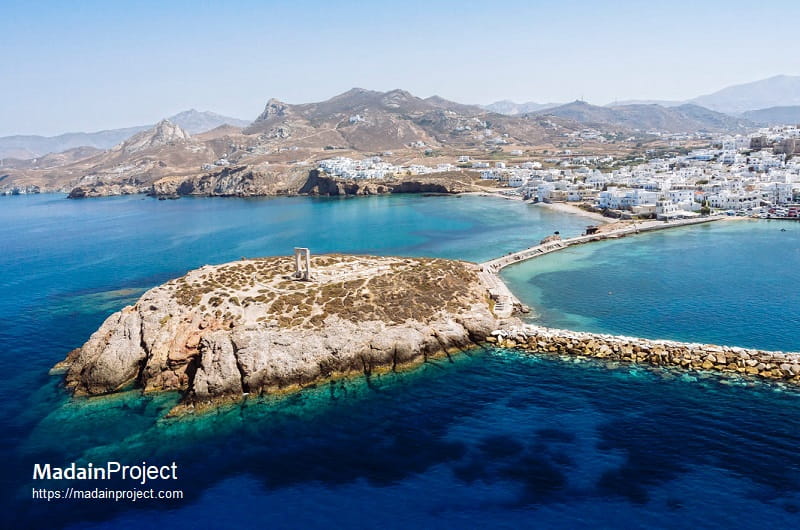
circa 530 BCE

The islet of Palatia, located appox 200 meters north-west of the coast of Naxos, has a long history of human activity. During prehistoric era, it was connected to the main island by a narrow isthmus, which may have served a strategic function and been fortified. By the 8th century BCE, the islet is believed to have hosted a sanctuary dedicated to Apollo, reflecting the island’s early religious significance. In the 7th century BCE, Palatia was captured and used as a military base by forces from Miletus and Erythrae, who launched assaults against Naxos, demonstrating the island’s contested political and maritime importance in the early Archaic period / Archaic Greece.
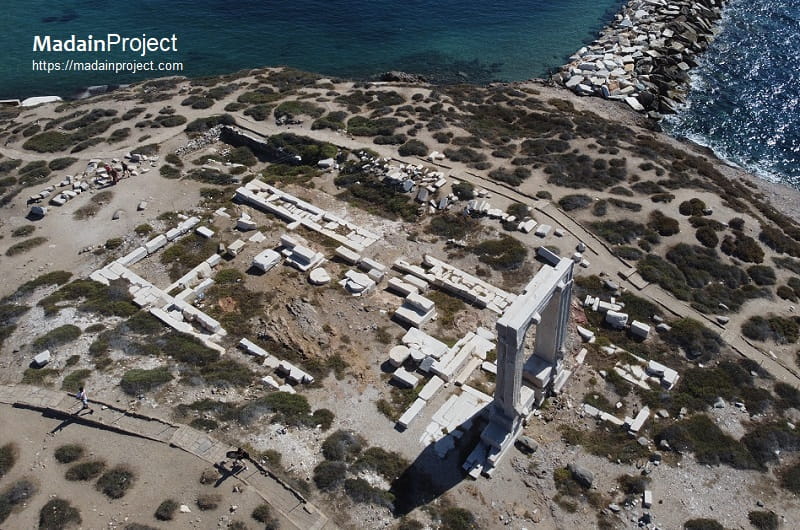
Around 530 BCE, the tyrant Lygdamis initiated an ambitious building program on Naxos, including the construction of a monumental Ionic temple on the islet. This project was part of a broader effort to consolidate his political power through public architecture and religious patronage. Construction ceased no later than 524 BCE, when Lygdamis was deposed by forces of the Peloponnesian League, led by ancient Sparta, leaving the temple unfinished. In later centuries, the site was adapted for Christian worship: in the 5th century CE, a church dedicated to Panagia Palatiani was built atop the temple ruins, followed by a 9th-century CE church dedicated to Saints Nicholas and Constantine. During the Venetian period, many of the temple’s materials were repurposed for the construction of the Kastro of Naxos, though the massive marble doorway remained in place due to its size and weight. Today, the islet and its monumental doorway, known as the Portara, stand as iconic symbols of Naxos.
circa 530 BCE
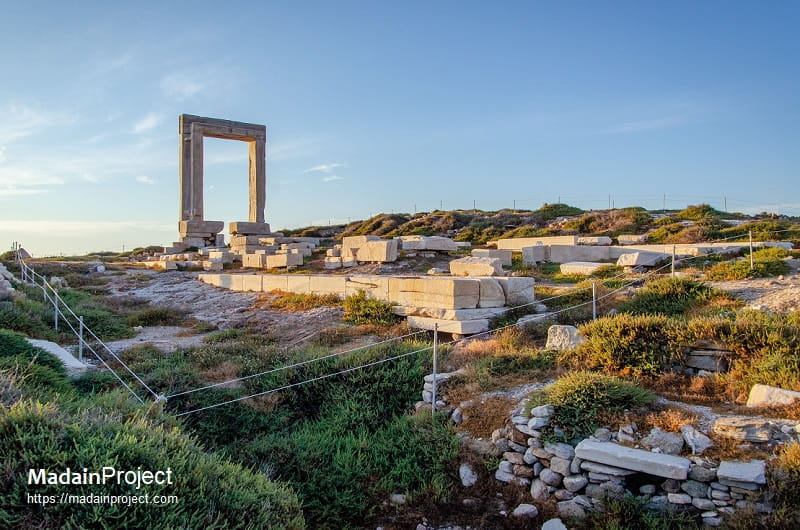
Portara Temple of Apollo
The so-called Portara temple, the monumental marble gateway of the unfinished Temple of Apollo on the islet of Palatia in Naxos, represents a significant exemplar of Archaic Greek architecture dating to the late 6th century BCE. Commissioned during the tyranny of Lygdamis, the structure was intended to be an ionic dipteral temple of colossal proportions, though political instability led to its abandonment in an incomplete state. Constructed from massive blocks of local Naxian marble, the lintel and jambs reach a height of approximately six meters, showcasing the technical precision of ancient masonry and the transition toward the Monumental style. Today, the gateway serves as a primary archaeological diagnostic for understanding the ambitious religious urbanism of the Cycladic islands during the transition from the Archaic to the Classical period.
Signup for our monthly newsletter / online magazine.
No spam, we promise.

The Madain Project is an online archive of Abrahamic History and Archaeology.
Abrahamic History & Archaeology is the study of history and archaeology with respect to the three Abrahamic Faiths without considering the religious and theological aspects. The goal of Abrahamic History is to understand how and why the religious doctrines and behaviours have evlovled and changed over time. Searching for patterns in the evolution of significant cultural events such as the development of farming, the emergence of cities, or the collapse of major civilizations for clues of why and how these have influenced the three major Abrahamic religions.
Cloud Drive -
About -
Help -
Privacy Policy -
Contact
Madain Project: Encyclopedia of Abrahamic History & Archaeology.
Copyright MadainProject 2017 - 2026.


